
From More Sales to Better Business: Porter’s Generic Strategies Explained
Use Porter’s strategies to grow smarter
Mustafa M A
5/9/20265 min read
Executive Viewpoint
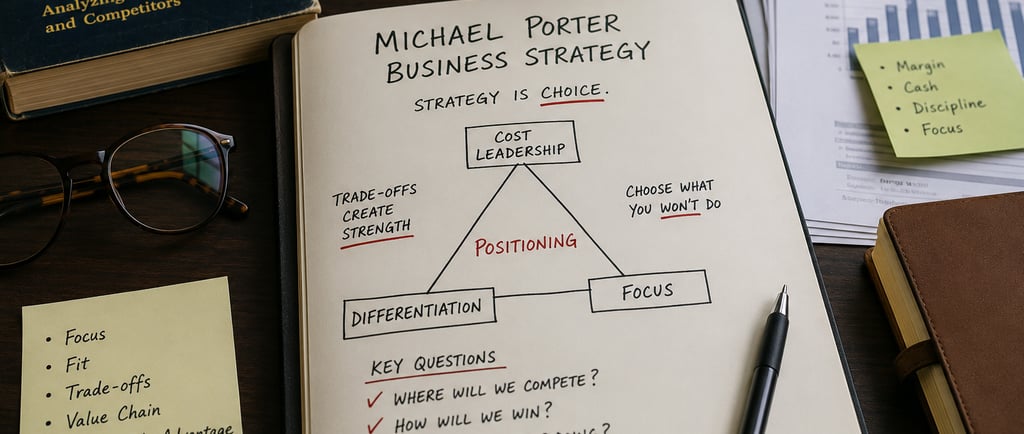
Many senior leaders fixate on top‑line growth and push their teams to “sell more.” In manufacturing, construction or project‑based businesses, chasing volume without a clear position in the market is a recipe for eroding margins and working‑capital headaches. Michael Porter’s generic strategies provide a simple but hard‑nosed lens for thinking about competitive advantage. They remind us that sustainable profit doesn’t come from doing everything for everyone; it comes from choosing how to win and aligning operations accordingly. In plainer terms, a firm either becomes the lowest‑cost producer, offers something uniquely valuable, or serves a niche better than anyone else. Anything else risks mediocrity.
Why It Matters Commercially
Profitability comes from more than revenue. Without a clear competitive position, rising input costs, price‑sensitive customers and aggressive rivals compress margins. Porter’s framework emphasises two types of advantage—low cost and differentiation—combined with the scope of customers you serve. Firms that choose one of these strategies and execute consistently tend to earn above‑average returns, whereas those that try to straddle everything get stuck in the middle and underperform. Understanding where you truly compete allows you to manage pricing, capacity, working capital and risk more effectively than a pure focus on sales volumes ever could.
The Three Generic Strategies
Cost Leadership
A cost‑leadership business seeks to produce and deliver at the lowest cost in its industry while offering acceptable value. The Cambridge Institute for Manufacturing notes that sources of cost advantage range from economies of scale to proprietary technology and preferential access to raw materials. Umbrex expands on this by emphasizing scale, process innovation, tight cost control, standardized offerings and asset utilization. For CFOs and operations directors, that means relentless discipline: design‑to‑cost, rigorous make‑buy decisions, minimal complexity and constant productivity improvements.
Benefits include resilience against price wars, bargaining power with suppliers and barriers to new entrants. But cost leaders must still meet basic customer expectations; if buyers see their products as inferior, they will have to discount prices to gain share. The lesson is clear: pursue cost leadership only if you can be the low‑cost producer; otherwise, a bruising race to the bottom awaits.
Differentiation
A differentiation strategy aims to be unique in ways that customers value. Cambridge’s summary highlights the need to select attributes buyers perceive as important and position the company to meet those needs uniquely. Umbrex stresses investing in brand, design, customer experience, reliability and innovation. By offering distinctive benefits, a firm can command premium prices, foster loyalty and reduce price sensitivity. Consider how Example technology brands combine sleek design with integrated ecosystems to justify higher margins.
However, differentiation comes with higher costs. To avoid eroding the premium, leaders must achieve cost parity or proximity—ensuring that extra features generate more value than they cost. Differentiation is also harder to sustain if rivals can imitate your attributes cheaply, so it demands continuous investment and clear intellectual property or brand protection.
Focus
The focus strategy restricts scope to a well‑defined segment—whether a niche industry, geography or customer type—and strives to serve it better than broad competitors. Within this narrow arena, a firm can choose either cost focus—being the low‑cost provider for that segment—or differentiation focus—offering specialized products or services. Success depends on deep insight into the segment’s needs and a tailored value chain. For example, a Typical pattern industrial equipment supplier might dominate the oil‑and‑gas aftermarket by stocking parts locally and offering 24/7 field service, even though its overall market share is small.
While focus can yield strong margins and loyalty, its limited scale poses risks. If the segment’s economics deteriorate or broader competitors tailor offerings to the niche, the focuser’s advantage may erode. Moreover, the temptation to expand beyond the niche can dilute the very factors that created the advantage. Executives must therefore balance concentration with diversification options in adjacent markets.
Trade‑Offs and the Danger of Being Stuck in the Middle
Porter argues that each generic strategy requires different, often incompatible activities. Low‑cost operations emphasize standardization, scale and efficiency, whereas differentiation demands variety, customization and innovation. Trying to combine both can lead to inconsistent processes, confused customer expectations and poor profitability. SM Insight illustrates this with the failed launch of a “luxury” fast‑food burger: a company known for low prices cannot suddenly persuade customers to pay a premium. The same applies in industrial markets; adding bespoke engineering services to a lean product platform may please a few customers but crush margins.
For leaders, the “stuck in the middle” warning is not theoretical. Hybrid positions only work when the activity system coherently supports both lower cost and differentiated value. Otherwise, resources are spread thin, pricing is unclear, and competitors pick you off. Choosing a strategy forces trade‑offs—where to invest, what to stop doing, and which customers you will not serve. Those choices ultimately protect margins and cash flow.
Shifting from Sales Obsession to Better Business
Many business owners equate success with top‑line growth. Yet more sales on a flawed business model simply accelerate cash burn and working‑capital strain. Porter’s framework reframes the conversation: instead of asking “How do we sell more?”, ask “How do we win profitably?” A cost‑leadership approach might mean simplifying your product line and negotiating supply contracts that free up cash. A differentiation play could involve investing in R&D and marketing to justify premium pricing and reduce reliance on volume. A focus strategy may lead you to exit commoditized segments and double down on a niche where you can command higher margins.
Choosing and executing one of these strategies requires hard operational decisions—closing non‑performing facilities, redesigning processes, investing in talent or technology, and potentially letting go of certain customer relationships. But it also sets a clear direction for pricing, capacity planning and working‑capital management, turning the business from a revenue machine into a value generator.
Practical Action Steps
Define your business scope. Clarify the unit of analysis—product line, geography or customer segment—and the competitive arena. Avoid muddled definitions that blur strategic choices.
Map customer segments and willingness to pay. Identify distinct customer groups, what they value and how much they are willing to pay. Use win/loss analysis, price testing or customer interviews to ground this assessment.
Diagnose your cost position. Build a cost tree of your value chain to understand where you have advantages and where you lag. Benchmark against industry peers to see whether cost leadership is attainable.
Choose your competitive advantage. Decide whether you will compete on cost, differentiation or focus, and be explicit about the scope of customers you will serve. Avoid the temptation to hedge.
Align activities to the chosen strategy. Redesign processes, organizational structure, supplier relationships and capabilities to reinforce your position. Eliminate activities that conflict with the strategy, and invest where it strengthens the value proposition.
Review and adapt. Monitor industry dynamics and competitor moves. If technology enables hybrid positions (e.g., using digital tools to reduce costs while enhancing customer experience), reassess whether the activity system still delivers consistent advantage.
Conclusion
Porter’s generic strategies are not an academic exercise; they are a practical lens for making hard commercial decisions. In GCC‑facing industries where capital intensity, margin pressure and complex supply chains are the norm, choosing how to compete is more critical than chasing “more sales.” Sustainable profit comes from focus, discipline and coherence—not from being all things to all customers. Business leaders who adopt a clear strategy, align their operations and measure success beyond top‑line growth move from a fragile sales‑driven model to a better business grounded in competitive advantage and cash‑generation.
References
Internal links
3Ms Business Consulting
Empowering businesses through strategic consulting solutions.
3Ms Business Operating System
© 2026. All rights reserved.